DeskSpace
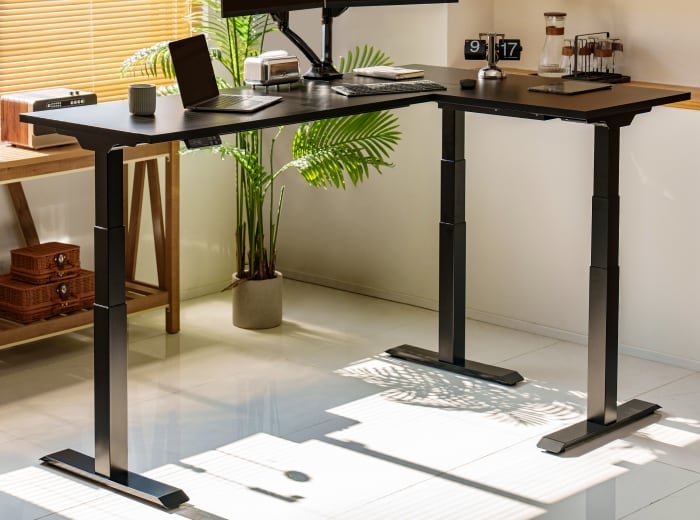
A second work wing is useful when it gives a separate task a place to stay: paper references, for example, beside a screen-and-keyboard area. Its orientation also decides which part of the room you give up. Before choosing an E7L, establish whether that extra task and a permitted return side justify the floor space.
The manufacturer describes reversible panels, but the selected top, supports and generation still need identification. This is an E7L planning reference, not a fitted configuration or a confirmed current offer. If one rectangular surface already serves the tasks, keeping that simpler outline remains an option.
Read the E7L page on its separate bases
The US Pro E7L family page, checked on October 13, 2026, contains description wording for E7L 2.0 and a separately labelled E7L table. E7L-Lite has its own page and is not an alias for the pictured E7L.
| Source block | What its wording identifies | What remains unresolved |
|---|---|---|
| E7L 2.0 description | A described configuration with generic load wording | Selected generation and the load's operating basis |
| E7L specification table | A separately labelled E7L record with a static-load field | Whether it describes the same shipped version; static is not a lifting limit |
| E7L-Lite page | A separate model and its own fields | Its specifications cannot fill an E7L record |
The description and table use different labels and values without establishing a common selected generation. Neither provides a confirmed moving-load comparison. Motor counts do not establish a speed, noise or stability ranking.
The height blocks do not explicitly settle whether the desktop is included. Obtain the selected configuration's finished positions and their measurement basis before adding the top again or relying on the lowest setting.
An adjustable width is not a finished L outline
The E7L table includes fields labelled Adjustable Width. Those fields cannot serve as a selected desktop outline, a usable surface area or the leg/foot footprint. The laminate, storage-laminate, bamboo and DIY sections also do not establish that any chosen top fits every frame revision.
Request the actual top drawing with both outer spans, wing depths and component joints. Match it to the frame, permitted return side and support layout. Then give each wing a task: a second empty surface offers less reason to accept the extra depth, furniture constraints and cable route.
A return side can change the room plan
Imagine a reader who wants a separate wing for paper references and has storage on the right of the proposed desk. A right return would share that storage zone. A left return could preserve it while retaining a place for the second task, but only if the actual top and frame permit that assembly.
These before-and-after sketches describe the proposed change, not a FlexiSpot product drawing. The storage stays in the same place; the second task moves to the other side.
The left-return proposal is a useful direction to investigate in this hypothetical room. It is not a clearance certificate: the real top, joints, legs, feet and movement still need checking. A plan-view overlap does not establish a physical collision at a particular height, and a clear plan view does not establish that the complete installation works.
Do not reverse an unidentified model by assumption. Obtain the permitted return side and matching assembly instructions first. If the second task can remain on the main surface, keeping a rectangular arrangement avoids the added return altogether. The E7, E7 Pro and E7 Plus comparison is a separate rectangular-desk research path, not an automatic replacement or stability verdict.
Complete the selected configuration record
Before relying on a room plan, collect these items for the actual offered desk:
- Frame/cart identifier, revision and matching manual cover.
- Selected top outline, component seams, return side and any supported DIY limits.
- Leg, foot and support footprint, with the chair approach and fixed furniture at every required height.
- Finished seated/standing surface range, plus explicit static and lifting definitions for the selected configuration.
- Full cable movement and a complete quote identifying included parts, delivery and applicable return conditions.
The family URL with a value parameter repeated the family output in the source read. The parameter alone does not verify the selected SKU, stock, top drawing or quote.
Once the outline and connections are identified, use the cable-routing guide to separate fixed devices from moving equipment across both wings. Choose a configuration only when its identified geometry serves the tasks and the full movement has been checked; keep the existing desk if those requirements are already met.
Sources and document limits
Manufacturer HTML references were checked on October 13, 2026, including cached retrievals. DeskSpaceLab has not tested E7L fitting, lifting or stability.
- FlexiSpot Pro E7L page — description and E7L table kept separate; width and height bases retained as labelled.
- FlexiSpot E7L family value URL — no selected configuration record exposed.
- FlexiSpot E7L-Lite page — separate model, not a source for the pictured E7L's limits.
The linked E7L manual and Laminate manual were detected as PDFs with no extracted text returned; their page contents were not read. Filename hints cannot identify the delivered frame or top, and no assembly steps, overlap, brackets or dimensions are inferred from those documents.
About this guide: An editorial research profile, not an individual reviewer. Explains model specifications, configuration choices and the limits of manufacturer evidence. Editorial profile
Keep planning your workspace.
Use the sources and related guides to choose your next step.
Explore standing desks →